
Inlays/Onlays
Dental Inlays/Onlays
When would my dentist use an inlay/onlay?
When a tooth is damaged or fractured, immediate treatment is crucial to preserve healthy tooth structure. However, dental crowns aren’t always necessary for full coverage. For less extensive damage, inlays or onlays are the preferred restorative solution.
How are Inlays and Onlays Different from Crowns?
Inlays and onlays are different from crowns because they cover smaller portions of the tooth. Dental crowns provide complete coverage of the tooth, which means the entire outer surface of the tooth needs to be trimmed down. The final trimmed tooth is called an abutment, upon which the crown will be cemented.
Besides their coverage, the material and fabrication process of crowns, inlays, and onlays are practically the same. They are all made of porcelain and custom-made in a dental laboratory. To create them, a mold of the damaged tooth needs to be taken so that the prosthetic will match the tooth as exactly as possible.
Gentle Tooth Repair: Ask About Inlays/Onlays
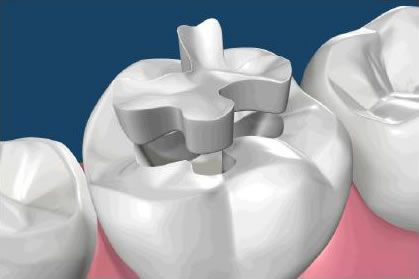
Dental Inlays
Dental Inlays are applied into the occlusal (biting) surface of the tooth, where you will find the deep grooves that often trap food. The best application of inlays is when you have a cavity in those deep grooves which has already extended near the dentin.
White fillings and dental bonding are not recommended for filling up big cavities because the material has a possibility to break or fracture. Inlays are made of porcelain and are fabricated in a separate laboratory. The end product is a very durable and resilient piece of molded restoration that is tailored to fit the damaged tooth.
Dental Onlays
Dental Onlays are closer to crowns than inlays because they cover the sides of the tooth, but not all of them. Also called ¾ crowns, onlays can cover one, two, or three sides of the tooth, leaving at least one side unchanged. The great advantage of onlays over crowns is that they don’t require the entire tooth surface to be removed, so more of the remaining healthy parts of the tooth can be preserved.
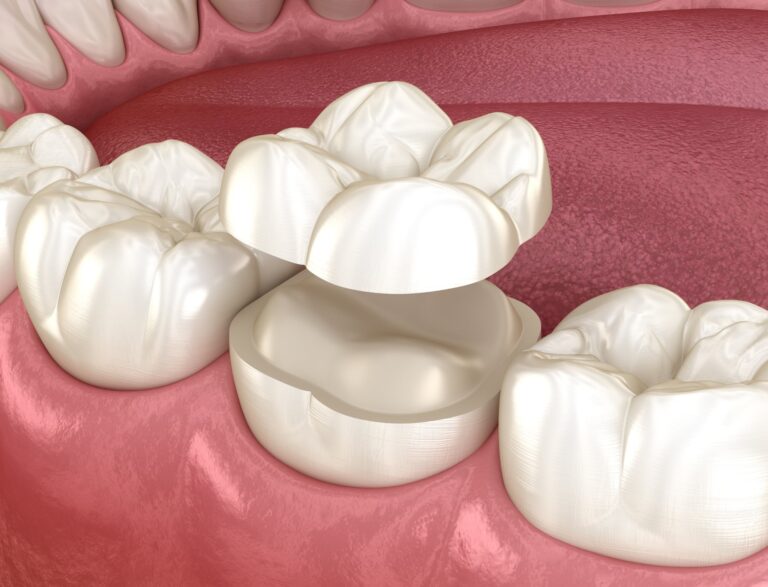
Benefits of Dental Inlays and Dental Onlays
Inlays and onlays are excellent restorations because they offer:
When you get a crown, your entire tooth will have to be trimmed down to form an abutment. Some healthy parts of the tooth may need to be removed just to make the crown fit. You can avoid this using inlays and onlays because they only need to replace damaged areas of the tooth.
Inlays and onlays are formed using an impression taken from your damaged tooth. This impression allows the dental technician to create a restoration that is custom-fitted to your tooth.
The tight fit and efficient coverage of inlays and onlays prevent the possibility of internal decay because bacteria will not be able to get into any tiny gaps between the restoration and the tooth. This will also keep the rest of the natural tooth structure free from damage.
Dental Inlays and Onlays can be colored to match the tooth and they are virtually invisible.
The price of dental inlays and dental onlays is significantly lower than that of dental crowns because of the smaller amount of material needed to create the restoration.
It is important to note that inlays and onlays have certain limitations, particularly in terms of coverage. Our dentist Dr. Karanvir Sibia, DDS, will help you decide whether you need a crown, an inlay, or onlay. She will closely examine your teeth and lay out all the possible solutions to fix your dental problems.
If Dr. Sibia recommends a dental crown instead of an inlay or onlay, this may be because the crown is more suitable and beneficial to restoring your damaged tooth. In such cases, you may discuss the options with him as well as their pros and cons to better understand what choice is best for you.